
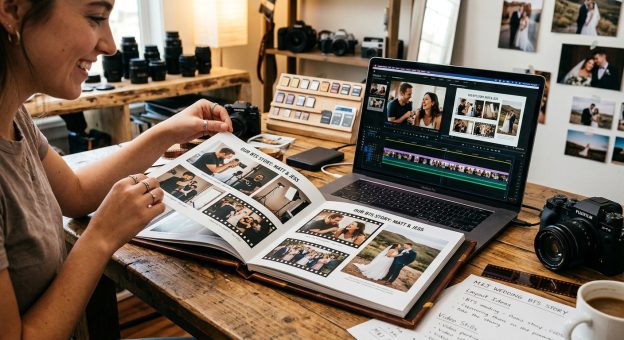
How to Turn Behind-the-Scenes Photography Videos into Album Stories
The photograph shows a father adjusting his daughter’s veil. Your recording catches what happened just before it: she asked whether he was nervous, and he admitted he had practiced this moment all morning. That small exchange changes how the picture feels. Behind-the-scenes footage can hold the words, gestures, and memories that help a photo album tell a personal story. Your job is to listen closely, choose carefully, and give those details room beside the images.
Start With Their Voice. Record a few thoughtful conversations and keep footage of the moments between posed photographs. Transcribe useful passages, check the wording against the audio, and choose details that explain what an image means to your client. Build a brief introduction around the album’s central feeling. Then add captions where words bring something new. Let clients approve personal passages before printing, and give the photographs enough space to carry their own emotion.
Find the Story Hidden Between the Photographs
A photo album already has a visual rhythm. Wide shots establish a place. Portraits bring people closer. Small details create pauses. Words can add another layer, but they need a purpose.
A useful caption tells the reader something the photograph cannot show. It might explain why someone wore a particular necklace. It could name the person missing from a family gathering. Or it might preserve a joke that made everyone laugh during a portrait session.
Start by asking what the client will want to remember years from now. The answer often sits outside the planned shot list. A child might care about the game their grandfather invented while waiting. A couple might remember the quiet drive to the ceremony more clearly than the decorations.
Look through the photographs before reviewing every minute of video. Mark images that feel emotionally rich but need context. These become useful starting points for your search through interviews and footage.
Record Conversations That Sound Like Real People
You do not need a formal interview setup to gather good material. A calm conversation before or after the session can give you plenty. Explain that you would like to use a few personal details in the album, and ask whether the client feels comfortable being recorded.
Make the conversation easy to leave or pause. Someone who enjoys having their portrait taken may still dislike answering personal questions on camera. Offer an audio recording or a written response if that feels more comfortable.
Ask about specific memories rather than requesting a speech about the occasion. Concrete questions tend to give people something clear to talk about.
- What were you thinking about just before this photograph?
- Which detail did you choose because it reminded you of someone?
- What happened today that you had not expected?
- Who helped you feel comfortable during the session?
- What would you want someone looking at this album in ten years to know?
Leave space after an answer. People sometimes add the most useful detail after a short silence. Avoid finishing their sentences or steering them toward an emotion you hope to include.
For behind-the-scenes footage, listen for everyday exchanges. A whispered reassurance can be more revealing than a polished answer. Keep recording boundaries clear, though. Permission to film a session should not become an assumption that every private conversation belongs in a printed album.
Give Each Recording Enough Context to Be Useful
A memorable sentence loses value if you cannot identify who said it or which moment it describes. Keep a simple record of the speaker, the occasion, and the recording filename. Add a timestamp when you hear something you may want to revisit.
During editing, work with copies of your original files. Keep client recordings in a location with appropriate access controls, and agree on how long you will retain them. Before uploading footage to any transcription service, check its handling of uploaded files and confirm that the client has agreed to that use.
You can organize possible story material in a basic document. Give each entry a recording reference, a short excerpt, related image filenames, and any approval notes. This makes it easier to trace a caption back to its source.
Context also helps prevent false connections. A client might describe an earlier family holiday while you are filming a birthday session. That memory could belong in the album, but the wording should make its timing clear.
Choose the Right Writing Style for Each Album Moment
Some photographs need the client’s exact voice. Others benefit from a short explanation written by you. Decide what the words need to do before choosing their form.
How Different Text Forms Support an Album
| Text Form | Best Use | What to Check |
|---|---|---|
| Direct quote | Preserving a distinctive phrase or personal reaction. | The words match the recording and the speaker approves their use. |
| Personal caption | Explaining a gesture, object, relationship, or small event. | The text adds context without guessing anyone’s feelings. |
| Narrative introduction | Giving the opening pages a sense of place and personal meaning. | The introduction reflects the client’s account and suits the images that follow. |
You can combine all three forms in one album. Keep their roles clear. An introduction opens the story. A caption adds local context. A quotation lets the client speak directly.
Turn MOV Recordings into Searchable Story Material
Once you have identified useful recordings, transcription helps you review the spoken material alongside your photographs. If your camera or phone saved the footage in MOV format, use MOV to text to prepare a transcript for review. Work with the recordings the client has agreed you may process.
Treat the transcript as a working draft. Play back any passage you plan to publish. Check names, dates, family relationships, and words spoken over background noise. A small transcription error can change the meaning of a personal memory.
Keep timestamps attached to promising passages. Label speakers when several people appear in the recording. If a sentence is unclear, ask the client what they said rather than repairing it through guesswork.
Read the transcript once for the overall story. Then read it again for specific details. Search for references to people, places, objects, traditions, and unexpected moments. Select meaningful quotes before pairing them with relevant images.
The strongest excerpt is not always the most emotional sentence. A simple remark about borrowed shoes may tell you more about a friendship than a broad statement about a wonderful day.
Pair Meaningful Quotes With Images That Earn Them
A quote and a photograph should have a clear relationship. They may show the same moment, feature the person being discussed, or connect through an object visible in the frame.
Imagine a client says, “Mum stitched that blue thread into my sleeve the night before.” Pair those words with a close photograph of the sleeve, or with an image of mother and daughter preparing together. A distant reception photograph would make the connection harder to understand.
This is an invented example, but it shows the value of specificity. The words explain why an ordinary detail deserves a place in the album.
Use these checks when deciding whether a passage belongs beside an image:
- Does it add information the photograph cannot provide?
- Does the image clearly connect to the person, detail, or event mentioned?
- Can the reader understand the passage without hearing the full interview?
- Does the wording preserve the speaker’s meaning and tone?
- Has the client approved any sensitive or personal detail?
Keep direct quotations faithful to the recording. If an excerpt needs extensive rewriting, turn it into an approved paraphrase and remove the quotation marks. Avoid joining separate remarks into a sentence the client never said.
A little roughness can belong in a quote. Family nicknames and familiar expressions often carry the person’s voice. Correcting every phrase into formal prose can erase what made the recording useful.
Write an Introduction Around One Personal Thread
An album introduction does not need to summarize every event. Choose one thread that gives the photographs a shared meaning. It might be a family returning to a familiar place, a couple making room for two sets of traditions, or parents noticing how much their child has changed.
Draft a short paragraph with three parts: a concrete opening detail, a little context, and a thought that leads into the images. Keep it grounded in the interviews and footage.
For a family album, an invented example might read: “Before anyone stood together for a portrait, the children raced toward the garden gate. Their father had played here at the same age. This afternoon brought three generations back to the house, with muddy shoes by the door and familiar stories around the kitchen table.”
The introduction establishes place, relationships, and atmosphere. It also gives the opening garden photographs a reason to appear first.
Choose the narrative voice deliberately. First person can feel intimate, but clients should approve writing presented as their own account. Third person can work well when you are shaping several interviews into one introduction. Avoid moving between voices without a clear reason.
Keep Captions Personal Without Filling Every Page
Captions work best when their length suits the layout. A short sentence may be enough beside a detailed photograph. A quieter spread might hold a slightly longer memory.
Replace broad descriptions with recorded details. “A beautiful family moment” tells the reader very little. “Grandad started the same clapping game he taught her father” gives the scene a history.
Do not infer an emotion from a facial expression alone. A thoughtful look might reflect nerves, tiredness, or concentration. Use what the client told you, or describe the visible action.
Some spreads need no text. Let a sequence of expressions, movements, or related details carry the story. Too many captions can interrupt the experience of looking.
Review the album at its intended print size. Check whether the text is comfortable to read, whether it competes with faces, and whether each caption sits close enough to its image. Consistent placement helps the reader follow the relationship between words and photographs.
Let Clients Recognize Themselves on the Page
Send the introduction and captions for review before final production. Ask clients to check names, relationships, factual details, and wording attributed to them. Give them a clear way to flag material they would prefer to keep private.
Read the text aloud during your own final review. A caption can be grammatically tidy and still sound unlike the person who inspired it. Remove phrases that feel too polished or emotionally overstated.
Return to the recordings whenever meaning feels uncertain. Those files are the source of the story, while the transcript and draft are tools for shaping it.
The finished album should feel familiar to the people inside it. Their photographs hold the visible moments. Their words preserve the small reasons those moments mattered. Bring the two together with care, and the album becomes something they can read, share, and return to as their memories change.